My grandmother grew up on a farm not far from where I live now, and when she was a little girl it was her job to make bread every day. Every day. She learned to make bread from her mother, and her mother learned it from her mother before her, and so on. She taught her daughters to make bread, and when my mother came to West Virginia as a young bride, my grandmother taught my mother to make that bread, too.
When I was nine years old, my mother taught me to make the bread. I made bread periodically as a teenager-it wasn’t “my job” like it was my grandmother’s job. We mostly bought bread at the store, but whenever anyone in the house made that bread, everyone was excited and it went quickly.
When I set up housekeeping for the first time as an adult, among the first things I bought were bread pans and a bag of flour. I had never been in charge of grocery shopping before, so I didn’t really think too hard about how long flour could last and how much flour is really needed to make just a loaf or two of bread. I bought a 25-pound bag of flour. That bag of flour lasted a long time! But I made a lot of bread, trying to use up that 25-pound bag, and I fell in love with baking.
I have two sons, and yes, of course, we can and should teach our sons their way around a kitchen, but there is just something about a bread recipe that has been passed down from mother to daughter for a hundred years or more in my family that makes it special that I have a daughter.
She is the only granddaughter in the family. When she was nine, I told her, “It’s time for you to learn how to make bread.” She asked where the recipe was. I told her, “There is no written recipe. I’m going to teach you and you’re going to remember it for the rest of your life and someday you’re going to teach it to your daughter.”
She looked a little doubtful at the prospect of actually remembering a recipe for that long, then she said, “Are you sure you’re the right person to teach me how to make bread? Aren’t you the one who blew up the bread pan??” Okay, yes, that did happen. It was an oven malfunction, I swear! The oven got too hot one day due to a temperature problem with the thermostat and when I took the pan out, the glass bread pan exploded everywhere and I was finding tiny bits of glass in corners for weeks. I reminded her that I’d made hundreds, maybe thousands of loaves of bread over the years and had only blown up one pan.
So we got started and I had her doing every step on her own, me just watching. She started stirring in the flour and she was getting a little tired of stirring and she said, “Don’t we have electronics for this now?” Well, yes, in fact I did have a bread machine once. It was a gift, and I tried it out a few times, but it’s just not homemade bread if it isn’t made by hand, and I have no idea where that bread machine is now.
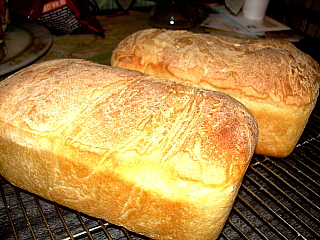 Making bread from scratch without using a bread machine takes some effort, but there are several benefits-for one thing, kneading bread is great exercise and good stress relief-but more importantly, putting your fist into the dough is like touching the past. People, particularly women, have done this very thing, stuck their fists into dough and kneaded it to a perfect elastic ball, for thousands of years. My mother, my grandmother, my great-grandmother, and my great-great-grandmother made this bread, stuck their fists into this dough. There are few things left in this sophisticated day and age that are more elemental, more intrinsic to human existence, more real, than making bread.
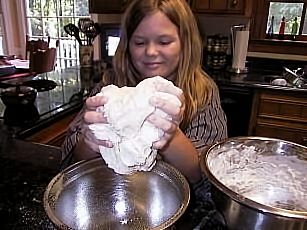 I explained all of this to my daughter, and her eyes glazed over slightly, then I pointed out, “You are the only granddaughter, remember? That makes you the Keeper of the Bread.” Now that made sense to her, and suddenly she was very proud. And once she got into it, she thought kneading was fun. All that punching, you know. Her first batch of bread turned out great, and she couldn’t stop reminding her brothers that she’d made it, all by herself, and to this day, she is proud to make what she named Grandmother Bread. The recipe is a longtime family secret, passed from hand to hand, never written down, but you can find it here. In a world where baking homemade bread is a dying art, maybe you can be a Keeper of the Bread, too. And if you’ve never made homemade bread, learn how to make bread with a nine-year-old.
Do you have any special recipe traditions that have been passed down for generations in your family? Or have you started any special recipe traditions of your own?
Posted by Suzanne McMinn @ 9:45 am |
Permalink
Related Posts

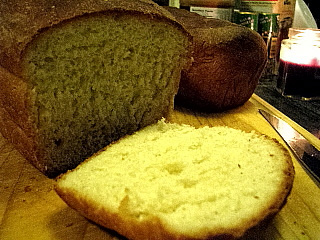 Deliciously simple and simply delicious, Grandmother Bread is a near-daily staple in our farmhouse. This is a heritage recipe, tested by time and the hands of mothers and grandmothers for over a hundred years. This secret family recipe is different from many standard white bread recipes in that it contains no milk or oil, and its very simplicity produces a bread of light but sturdy texture that yields loaves for perfectly sliced sandwich bread (the best sandwich bread you’ll ever taste! also makes excellent french toast!), plus the same dough can be used to create dinner rolls, cinnamon-swirl loaves, sweet rolls, crispies, and apple-streudel ladder loaf.
Read all about the family history behind this bread recipe here.
Never baked homemade bread before? Learn how to make bread here.
How to make Grandmother Bread:
2 1/2 cups very warm water (sometimes I use 3 cups to make larger loaves!)
1 package yeast
1/2 teaspoon salt
1/3 cup sugar
5 1/2 cups all-purpose flour
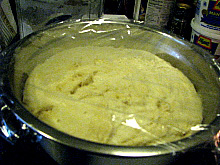
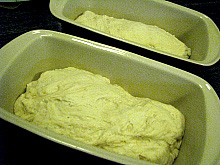
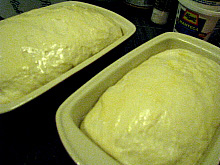
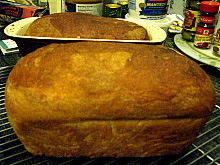
In a large bowl, combine water, yeast, sugar, and salt. Let sit five minutes. Stir in first three cups of flour with a heavy spoon. Add the next cup of flour a little at a time as needed, stirring until dough becomes too stiff to continue stirring easily. Add a little more flour and begin kneading. The 5 1/2 cups flour is approximate-your mileage may vary! Continue adding flour and kneading until the dough is smooth and elastic. Let dough rise in a greased, covered bowl until doubled. (Usually, about an hour.) Uncover bowl; sprinkle in a little more flour and knead briefly before dividing in half. With floured hands, shape dough into loaves and place in two greased loaf pans. Tear off two pieces of plastic wrap and grease with oil spray (to prevent it from sticking to the loaves as they rise) and cover loaf pans. Let rise till loaves are tall and beautiful! (About an hour, depending on the temperature in your kitchen.)
Bake for 25 minutes in a preheated 350-degree oven. Makes two loaves. Recipe can be cut in half or doubled.
Also try Whole Grain Grandmother Bread and find out How to Make Homemade Dough Enhancer for 100% whole wheat bread!
Dinner rolls:
After the first rise, divide dough into balls and place in a large casserole dish or on a baking sheet. Let rise. Bake at 350-degrees for 15 minutes.
To make brown-and-serve rolls: Bake rolls for 8 minutes. Do not brown. Remove from oven and cool. Store in freezer-safe wrappings or containers. To serve-defrost for 15 minutes then bake at 350-degrees about 10 minutes or till browned.
Cinnamon-Swirl Bread:
After the first rise, divide dough in half. Roll each half out on a floured surface into an approx. 12-inch by 7-inch rectangle. Brush lightly with approx. 1/3 cup melted butter. Combine 1/2 cup sugar and 2 teaspoons cinnamon. (Want more cinnamony sweetness? Double the sugar-cinnamon!) Sprinkle half of the sugar-cinnamon mixture over each half. Roll up. Place seam-side down in loaf pans. Let rise and bake at 350-degrees for 25 minutes. If desired, immediately after removing baked bread from oven, drizzle tops with powdered sugar icing.
To make powdered sugar icing: Mix 1 cup powdered sugar, 1/2 teaspoon vanilla, and 1 tablespoon of milk at a time until the mixture is of drizzling consistency. (If you like a lot of icing, double recipe.)
Sweet Rolls:
After the first rise, divide dough in half. Roll each half out on a floured surface into an approx. 12-inch by 7-inch rectangle. Brush lightly with approx. 1/3 cup melted butter.
For Cinnamon Rolls: Combine 1/2 cup sugar and 2 teaspoons cinnamon. Sprinkle half of the sugar-cinnamon mixture over each half. (Add raisins if desired.) Roll up from one of the long sides and seal seams. Slice dough into 12 pieces. Repeat with second half. Place rolls on large greased baking sheet or two greased round cake pans. Let rise till doubled. Bake in 350-degree oven for 20-25 minutes. Invert on serving dish. Drizzle with powdered sugar icing as described above.
For Caramel-Pecan Rolls: Combine 1/2 cup sugar and 2 teaspoons cinnamon. Sprinkle half of the sugar-cinnamon mixture over each half. Roll up from one of the long sides and seal seams. Slice dough into 12 pieces. Repeat with second half. Mix 1 cup of brown sugar, 1/2 cup butter, and 2 tablespoons light corn syrup in a small pot. Cook and stir till combined and melted together. Pour into large greased casserole dish or divide between two greased round cake pans. Sprinkle the pan(s) with 1 cup chopped pecans. Place rolls in pan(s). Let rise till doubled. Bake in 350-degree oven for 20-25 minutes. Invert on serving dish.
Cinnamon Crispies:
After the first rise, roll out each half of the dough on a floured surface into a 12-inch square. Brush on 1/4 cup melted butter. Combine 1/2 cup sugar, 1/2 cup brown sugar, and 1/2 teaspoon cinnamon. Spread over buttered dough. Roll up each half, seal seams, and cut into 12 pieces. Place on greased baking sheets a few inches apart. Use the bottom of a glass to flatten pieces. Let rise for 30 minutes then cover the rolls with waxed paper and use a rolling pin to flatten the rolls again. Brush rolls with more melted butter. Sprinkle with more cinnamon and sugar. Bake at 400-degrees for 8-10 minutes. Serve sprinkled with powdered sugar. See full Crispies post.
Apple-Streudel Ladder Loaf:
After the first rise, divide dough in half, and roll each half into an 8-inch square on a floured surface. Brush a few tablespoons of melted butter on each square. Combine 1/4 cup brown sugar, 1 tablespoon all-purpose flour, 1 teaspoon cinnamon, and 2 cups chopped, peeled apples for filling. Spread half of the filling down the middle of each square of dough. At the sides of the filling, cut the dough at 1-inch intervals. Fold dough strips over the filling to wrap. Carefully move filled loaves to greased baking sheets. Brush tops with more melted butter; sprinkle with sugar. Let rise till doubled. Bake at 350-degrees for 30 minutes. (Try peaches in this recipe or add nuts-it’s all good!) Serve warm slices with ice cream. See full Apple-Streudel Ladder Loaf post.
Favorite Farmhouse Treat: Slice original Grandmother Bread, toast, spread with butter, and top with homemade pumpkin butter. So simple. So good.
Have breakfast with Grandmother Bread! Egg Grandwiches, Stuffed French Toast, Cheesy Poached Eggs (and more!).
More recipes with Grandmother Bread:
Shrimp Toast
Garlic-Herb Croutons
Fried Bologna Sandwiches
Raisin Bread
The Farmhouse Table Index
Main How to Do Stuff Index
 Printable Recipe
Posted by Suzanne McMinn @ 9:45 am |
Permalink
Tags:
yeast breads
Related Posts